



Maintaining an accurate public profile on decentralized business directories has become a critical milestone for growing enterprises looking to secure regional market share. Discovering how to delete a review on yelp is a top priority for business owners facing unfair, toxic, or fraudulent customer complaints. At Good Review Service, we understand that navigating directory moderation rules can be incredibly complex and slow. This 2026 master guide, curated by Good Review Service, outlines what an enterprise can legally execute under platform policies, breaks down the steps to report violations, and demonstrates how to build long-term digital trust.
Can You Delete a Yelp Review?
The immediate, direct answer for commercial business owners is no. Yelp does not provide an administrative “delete” button inside your corporate owner profile. This structural rule exists to preserve absolute transparency; if companies could independently erase any low-star feedback, the platform’s consumer trust metrics would disappear.
However, this policy does not mean you are completely helpless when hit with malicious text. While you cannot directly erase a post, you hold the legal right to submit a formal removal request if an entry actively breaks the platform’s Terms of Service. If a moderator agrees that the text violates company rules, Yelp will remove the entry from the web entirely.
How to Delete a Review on Yelp
Receiving a negative review can be incredibly frustrating, especially when you work hard to provide excellent service. However, when it comes to removing feedback on Yelp, the process depends entirely on whether you are the business owner receiving the review or the customer who wrote it.
The honest truth is that business owners cannot simply delete a review they disagree with. Yelp has strict policies to protect consumer voices. However, you can have a review removed if it violates Yelp’s Content Guidelines. On the other hand, if you are a user who wants to take down a review you previously wrote, the process takes only a few clicks.
Here is the step-by-step guide for both scenarios.
How Business Owners Can Remove a Yelp Review
If you are a business owner, you can only get a review removed if you successfully report it to Yelp’s moderators for violating their Terms of Service. Valid reasons for removal include hate speech, fake reviews from competitors, conflicts of interest, or reviews that do not detail a firsthand consumer experience.
- Log into Yelp for Business: Access your business dashboard via a desktop browser or the Yelp for Business mobile app.
- Navigate to the Reviews Section: Locate the specific review you believe violates Yelp’s guidelines.
- Report the Review: Click on the three dots (More Options) next to the review and select the Report Review flag icon.
- State Your Case: A prompt will ask you to explain why the review violates Yelp’s Content Guidelines. Be concise, objective, and provide specific evidence (e.g., “This person is a former employee,” or “This review contains explicit threats”).
- Wait for Evaluation: Yelp’s human moderators will evaluate the report. This process usually takes a few days. You will receive an email notification detailing their final decision.
Strategic Tip for Businesses: If the review is legitimate but simply negative, Yelp will not remove it. Your best strategy is to reply publicly, apologize for the poor experience, and offer to resolve the issue offline. Often, a customer will voluntarily delete or update their bad review if the business owner makes things right!
How Users Can Delete Their Own Yelp Review
If you are a consumer and you want to remove a review you previously published—perhaps because the business resolved your issue or you simply changed your mind—you have full control to delete it at any time.
- Log into Your Personal Yelp Account: Open Yelp on your desktop browser or launch the Yelp mobile app.
- Access Your Profile: Click on your profile picture in the top right corner (on desktop) or tap the “Me” icon at the bottom of the screen (on mobile).
- Go to Your Reviews: Select Reviews from your profile menu to see a list of all the feedback you have ever posted.
- Find the Specific Review: Scroll down until you locate the exact review you wish to remove.
- Delete the Post: Click the Trash Can icon (on desktop) or tap the three dots and select Remove Review (on mobile).
- Confirm Deletion: Yelp will ask you to confirm your choice. Once you click confirm, the review will be permanently deleted from the business’s page and your profile.
Yelp Content Guidelines That Can Lead to Review Removal
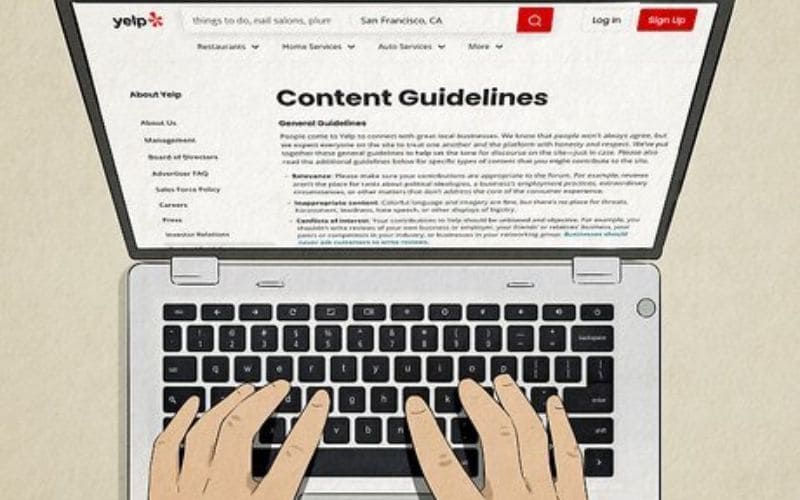
To win a removal request, you cannot simply argue that you dislike a customer’s opinion or that a rating hurts your local conversions. Your report must explicitly map the text to a clear violation of Yelp’s official Content Guidelines.
- Conflicts of Interest: Reviews must be entirely unbiased. If an entry is written by a direct market competitor looking to damage your standing, a disgruntled former employee, or an individual paid to execute a targeted smear campaign, it qualifies for instant removal.
- Second-Hand or Off-Topic Experiences: Text must detail a personal, first-hand consumer journey. If a reviewer states they “heard from a friend” about a bad experience, or if they use your page to launch a political rant regarding corporate policies rather than evaluating your product fulfillment, the content is completely irrelevant.
- Inappropriate Content and Personal Attacks: The platform maintains a zero-tolerance policy for explicit language, hate speech, clear harassment, or direct threats of violence directed at your field staff.
- Privacy Violations: If a reviewer posts private, confidential personal information – such as publishing a technician’s personal cell phone number, home address, or full legal name to incite public shaming – the post breaks privacy rules.
How Yelp Detects Suspicious or Fake Reviews
The Three Pillars of Yelp’s Detection Algorithm
Yelp’s software evaluates hundreds of data points simultaneously, but its detection methods primarily focus on three core areas:
1. Reviewer Trustworthiness and Account History
The algorithm evaluates the user behind the words just as much as the review itself. It looks for patterns that mimic a real person actively participating in a community.
Active Profiles: Users who have an established history on Yelp-meaning they have a profile picture, linked social accounts, friends on the platform, and regularly review various types of businesses—are considered highly trustworthy.
The “One-Hit Wonder” Flag: If an account is completely anonymous, lacks a profile picture, and has only ever left a single five-star or one-star review, the algorithm will likely flag it as suspicious and filter it out.
2. Sharp Spikes in Review Volume (Velocity)
Natural word-of-mouth feedback grows organically over time. When a business experiences a sudden, uncharacteristic surge in review volume, it triggers an immediate red flag.
Viral Triggers: If a business gets mentioned in the news or goes viral on TikTok for a political or controversial incident, hundreds of people may flood their Yelp page to leave politically charged reviews. Yelp’s algorithm detects this sudden spike and will often temporarily lock the page to prevent “review bombing.”
Review Solicitations: A massive influx of positive reviews over a 48-hour period often indicates a business just ran a campaign offering discounts or incentives for five-star ratings—a practice strictly banned by Yelp.
3. Technical Signals and Metadata
Yelp tracks behind-the-scenes data to ensure the reviewer actually visited the business and isn’t a click farm operating from across the globe.
IP Address and Location Data: If a local coffee shop in Chicago suddenly receives five-star reviews from IP addresses located in Eastern Europe or Southeast Asia, the system automatically filters them as fake.
Device Fingerprinting: If multiple different Yelp accounts submit reviews for various businesses from the exact same phone or computer, the system flags it as a single user manipulating the system.
How to Respond to Negative Yelp Reviews Professionally
While waiting for a moderator to complete their policy evaluation, you must deploy a polished public response to protect your brand entity in front of everyday web browsers.
Always begin your public reply by thanking the user for taking the time to share their feedback, keeping your tone completely objective, professional, and calm. Apologize sincerely for the fact that their experience did not align with your premium company standards, but completely avoid getting into a defensive, line-by-line argument over the technical details.
Factually outline your core company protocol, keep your message brief, and immediately provide a direct, offline communication channel – such as an internal customer care phone line or executive email address, to resolve the issue privately out of the public eye.
What to Do if Yelp Refuses to Remove the Review
If platform moderators evaluate your flag and ultimately decide to uphold the negative entry, you must shift your focus toward long-term reputation recovery.
Continue Responding Professionally
Leave your polite, solution-oriented public response pinned to the entry. Prospective clients reading through your history will evaluate your professionalism based on how you handle friction, often viewing a mature corporate response as a massive signal of business maturity.
Generate More Positive Yelp Reviews Naturally
The single most effective way to neutralize an unfair 1-star rating is to drown it out with an organic wave of glowing 5-star feedback. Because the recommendation software favors active listings, consistently securing genuine consumer validations naturally pushes historic negative text down the page.
Improve Customer Experience and Reputation
Use negative commentary as an internal audit tool to evaluate your fulfillment chain. If authentic reviews frequently point out a specific delay or a breakdown in staff communication, fixing that internal operational bottleneck naturally prevents future customer complaints.
Focus on Long-Term Reputation Management
A single low rating can only damage your bottom line if your digital footprint is completely bare. Transitioning away from a passive approach and building a robust, multi-channel trust framework ensures your enterprise maintains an undeniable aura of authority.
Final Thoughts
Understanding the formal procedures required to flag policy-violating content ensures that your business entity remains protected against fraudulent digital attacks. By combining strict data compliance, fact-based removal requests, and exemplary customer service responses, you ensure your public storefront remains polished and highly competitive.
However, executing defensive cleanups is only half the battle. To truly dominate your market, your brand must support its presence with undisputed, active public confidence.
Don’t let an unfair negative rating limit your conversion potential. Contact Good Review Service Today to explore how our specialized reputation tools can supercharge your review acquisition strategy. Let us help you align your live public feedback with your growth goals to turn casual internet browsing into lifelong business success!