



Managing multiple Google Ads campaigns without a structured workflow often leads to wasted budget, inconsistent messaging, and limited performance visibility. Google Campaign Management solves these challenges by centralizing campaign planning, optimization, audience targeting, bidding strategies, and performance tracking into a single, data-driven process. In this guide, Good Review Service will walk you through everything you need to know about Google Campaign Management – from its core principles and best practices to advanced optimization techniques that help maximize ROI and scale your advertising results efficiently.
What Is Google Campaign Management?
Google Campaign Management is the process of creating, monitoring, optimizing, and scaling Google Ads campaigns to achieve specific marketing goals, such as generating leads, increasing sales, or driving website traffic. It involves managing keywords, audiences, budgets, bidding strategies, ad creatives, and conversion tracking to maximize campaign performance. Instead of setting up ads once and leaving them unchanged, Google Campaign Management focuses on continuous optimization based on performance data, helping businesses improve ROI, reduce wasted ad spend, and reach the right audience more effectively.
What Does Google Campaign Management Include?
Google Campaign Management includes a series of ongoing activities that help businesses plan, execute, optimize, and measure Google Ads campaigns effectively.
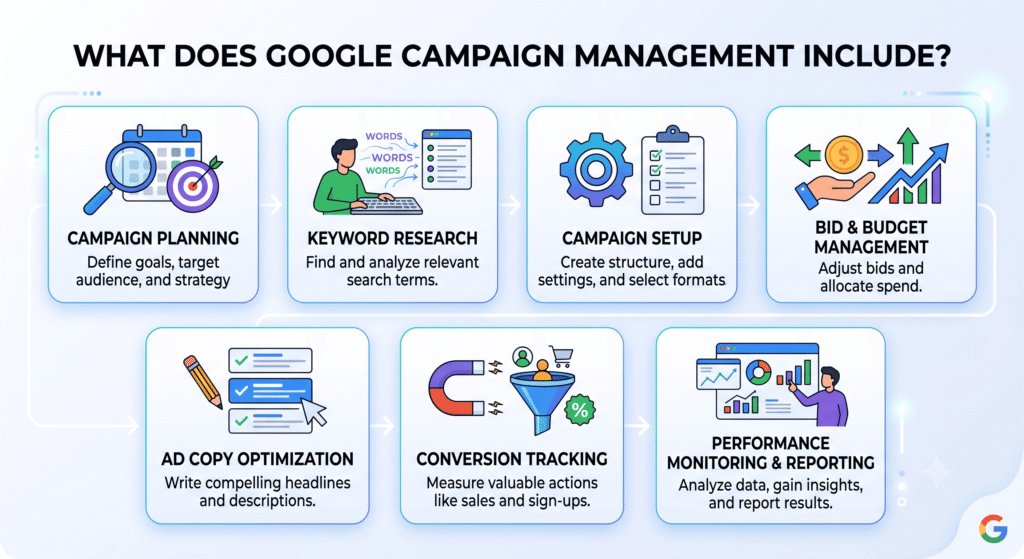
Campaign Planning
Campaign planning defines the campaign objective, target audience, budget, and overall strategy before launch. Typical responsibilities include:
- Defining campaign goals and KPIs
- Identifying target audiences
- Selecting campaign types
- Planning campaign structure
- Allocating advertising budgets
- Choosing bidding strategies
- Creating a campaign timeline
Keyword Research
Keyword research identifies the most valuable search terms to target in Google Ads campaigns. Common tasks include:
- Finding high-intent keywords
- Analyzing search intent
- Grouping keywords by theme
- Selecting keyword match types
- Building negative keyword lists
- Evaluating search volume and competition
- Updating keyword lists regularly
Campaign Setup
Campaign setup prepares every campaign component before ads go live. Key tasks include:
- Creating campaigns and ad groups
- Configuring campaign settings
- Setting location and language targeting
- Selecting devices and audience targeting
- Adding keywords
- Creating responsive search or display ads
- Implementing ad assets (extensions)
Bid & Budget Management
Bid and budget management ensures advertising spend is used efficiently. Typical responsibilities include:
- Setting daily budgets
- Choosing bidding strategies
- Adjusting keyword bids
- Optimizing bids by device, location, or audience
- Reallocating budgets between campaigns
- Controlling advertising costs
- Improving ROAS through bid optimization
Ad Copy Optimization
Ad copy optimization improves ad engagement and conversion rates through continuous testing. Typical tasks include:
- Writing compelling headlines
- Creating persuasive descriptions
- Developing strong calls to action
- Testing multiple ad variations
- Improving keyword relevance
- Updating ad messaging based on performance
- Pausing low-performing ads
Conversion Tracking
Conversion tracking measures whether campaigns generate valuable business actions. Common tasks include:
- Setting up conversion actions
- Installing Google Ads tracking tags
- Integrating Google Analytics
- Tracking leads, sales, and phone calls
- Verifying tracking accuracy
- Monitoring conversion performance
- Using conversion data for optimization
Performance Monitoring & Reporting
Performance monitoring and reporting help identify opportunities to improve campaign results. Typical tasks include:
- Monitoring campaign KPIs
- Tracking CTR, CPC, CPA, conversions, and ROAS
- Identifying underperforming campaigns
- Analyzing audience and keyword performance
- Creating performance reports
- Recommending optimization actions
- Measuring progress against campaign goals
Benefits of Professional Google Campaign Management
Professional Google Campaign Management improves campaign performance by combining strategic planning with continuous optimization. Instead of relying on trial and error, businesses can make data-driven decisions that generate better advertising results over time.
Better ROI: Professional campaign management helps maximize return on investment by focusing on the campaigns, keywords, and audiences that generate the highest value. Rather than increasing ad spend, ongoing optimization ensures more revenue is generated from the existing budget.
Lower Cost Per Click: A well-managed campaign can lower cost per click by improving Quality Score, refining keyword targeting, and creating more relevant ads. Higher ad relevance often leads to better ad positions while reducing the amount paid for each click.
Higher Conversion Rate: Driving traffic is only valuable when visitors take action. Professional management continuously optimizes audience targeting, ad copy, landing pages, and bidding strategies to turn more clicks into leads, inquiries, or sales.
Smarter Budget Allocation: Not every campaign delivers the same results. Performance data is used to shift budgets toward the highest-performing campaigns while reducing investment in ads that produce lower returns, helping businesses spend more efficiently.
Continuous Optimization: Google Ads requires ongoing management because search trends, competition, and user behavior change over time. Regular performance reviews, A/B testing, keyword refinement, and bid adjustments keep campaigns competitive and maintain consistent growth.
Google Campaign Management Process
An effective Google Campaign Management process follows a structured workflow that turns business objectives into measurable advertising results. Each stage builds on the previous one, ensuring campaigns are optimized from planning through long-term performance improvement.
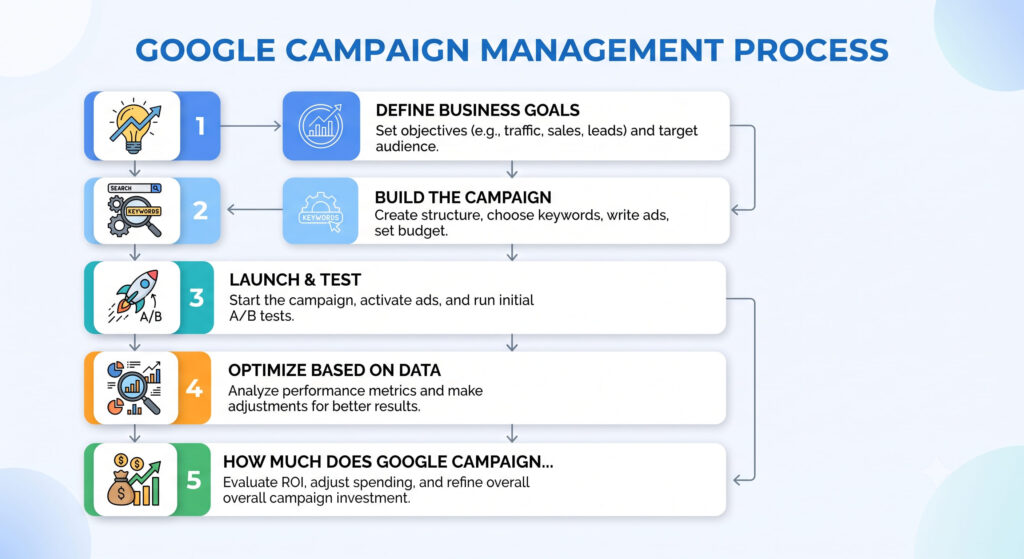
Define Business Goals
Every successful campaign starts with a clear business objective rather than a marketing metric. The campaign strategy, bidding model, budget, and conversion tracking should all support the primary goal.
For example:
- Lead generation: Optimize for form submissions, phone calls, or quote requests.
- Ecommerce sales: Focus on purchases, ROAS, and average order value.
- Brand awareness: Maximize impressions and reach.
- Website traffic: Drive qualified visitors with high click-through rates.
- App promotion: Optimize for installs or in-app actions.
At this stage, advertisers should also define KPIs such as CPA, ROAS, conversion rate, or monthly lead targets to measure campaign success accurately.
Build the Campaign
Campaign creation involves more than simply writing ads. A well-structured account improves Quality Score, simplifies optimization, and gives Google’s algorithm better signals for automated bidding.
A typical campaign build includes:
- Choosing the appropriate campaign type (Search, Performance Max, Display, Shopping, Video, or Demand Gen)
- Segmenting campaigns by product, service, location, or business objective
- Creating tightly themed ad groups
- Performing keyword research and selecting match types
- Building negative keyword lists
- Writing multiple responsive search ads
- Adding assets such as sitelinks, callouts, structured snippets, call extensions, and image assets
- Configuring audience, location, language, schedule, and device targeting
- Setting bidding strategy and daily budget
- Implementing conversion tracking before launch
A clean campaign structure makes future optimization significantly easier.
Launch & Test
Launching a campaign is the beginning of the optimization cycle – not the final step. Initial performance data should be collected before making major changes, allowing Google’s learning phase to stabilize.
During the testing phase, campaign managers typically evaluate:
- Click-through rate (CTR)
- Search term relevance
- Cost per click (CPC)
- Conversion rate
- Cost per acquisition (CPA)
- Impression share
- Budget pacing
Testing usually involves experimenting with:
- Different ad headlines and descriptions
- Calls to action
- Landing pages
- Bidding strategies
- Audience segments
- Keyword match types
The goal is to identify which combinations generate the strongest performance before scaling spend.
Optimize Based on Data
Long-term success depends on continuous optimization rather than one-time setup. Every optimization decision should be supported by campaign data instead of assumptions.
Common optimization activities include:
- Pausing underperforming keywords
- Expanding high-converting keyword groups
- Adding new negative keywords
- Adjusting bids by device, location, audience, or schedule
- Reallocating budget toward high-performing campaigns
- Improving ad relevance and Quality Score
- Refreshing ad creatives to prevent performance decline
- Analyzing search term reports
- Optimizing landing page conversion rates
- Reviewing conversion attribution and ROAS regularly
Because Google Ads auctions change continuously, ongoing optimization is essential for maintaining profitability and outperforming competitors.
How Much Does Google Campaign Management Cost?
The cost of Google Campaign Management varies depending on campaign complexity, advertising budget, the number of campaigns managed, and the level of optimization required. There is no fixed pricing model, but most agencies and freelancers use one of the following structures:
- Monthly flat fee: Best for businesses with stable campaign requirements and predictable management needs.
- Percentage of ad spend: Commonly used for larger accounts, where the management fee scales with the advertising budget.
- Performance-based pricing: Fees are tied to agreed KPIs such as qualified leads, conversions, or revenue, although this model is less common due to the many factors that influence campaign performance.
- Hourly consulting: Suitable for audits, troubleshooting, account restructuring, or strategic guidance instead of ongoing management.
When comparing providers, businesses should evaluate more than the management fee. The scope of services – such as keyword research, campaign setup, conversion tracking, reporting, A/B testing, landing page recommendations, and ongoing optimization – has a much greater impact on long-term ROI than price alone.
How Much Does Google Campaign Management Cost?
Google Campaign Management typically costs $300–$10,000+ per month, depending on your monthly ad spend, campaign complexity, and the agency’s pricing model. Small businesses usually pay a few hundred dollars per month, while enterprise accounts with large advertising budgets often invest several thousand dollars for ongoing management.
Common Pricing Models
Most Google Ads agencies use one of the following pricing structures:
| Pricing Model | Typical Cost |
|---|---|
| Flat monthly fee | $300–$2,500+/month |
| Percentage of ad spend | 10%–20% of monthly ad spend |
| Hourly consulting | $75–$250/hour |
| One-time campaign setup | $500–$5,000 |
| PPC account audit | $250–$2,000 |
For example:
- A business spending $2,000/month on Google Ads may pay $300–$600/month for management.
- A company spending $10,000/month may pay $1,000–$2,000/month under a percentage-based model.
- Enterprise advertisers spending $50,000+/month often negotiate custom pricing.
Learn more:
- Instagram Ads Cost in 2026: Full Breakdown of Pricing, Budget & Real-World Ranges
- TikTok Ads Cost in 2026: Pricing, Budget Requirements, and Real ROI Expectations
Factors Affecting Pricing
Management fees are influenced by more than advertising budget alone. Agencies typically consider:
- Monthly ad spend: Larger budgets usually require more optimization and reporting.
- Number of campaigns: Managing 20 campaigns takes significantly more effort than managing three.
- Campaign types: Performance Max, Shopping, Video, and Demand Gen campaigns often require additional expertise beyond standard Search campaigns.
- Business size: Ecommerce stores with hundreds of products generally require more management than local service businesses.
- Reporting frequency: Weekly strategy meetings and custom dashboards increase management time.
- Additional services: Landing page optimization, conversion tracking setup, Google Analytics integration, and A/B testing may be included or charged separately.
The cheapest option is not always the most cost-effective. An experienced Google Ads manager who consistently improves ROAS and lowers CPA can generate significantly greater returns than a lower-cost provider offering only basic campaign maintenance.
FAQs About Google Campaign Management
How Often Should Google Ads Campaigns Be Optimized?
Google Ads campaigns should be monitored daily and optimized at least once a week. High-budget or high-volume campaigns often require more frequent adjustments to bids, budgets, keywords, and ad performance.
What Metrics Should I Track in Google Ads Campaigns?
The most important metrics include CTR, CPC, Conversion Rate, CPA, ROAS, Quality Score, Impression Share, and Conversions. Together, these KPIs provide a clear picture of campaign performance and profitability.
Can Google Campaign Management Improve Existing Campaigns?
Yes. Professional Google Campaign Management can improve existing campaigns by optimizing keywords, bidding strategies, ad copy, audience targeting, budgets, and conversion tracking to increase ROI and reduce wasted ad spend.
How Long Does It Take to See Better Results?
Most campaigns begin showing measurable improvements within 2–4 weeks, while significant performance gains typically require 1–3 months of continuous optimization and data collection.
What Information Does a Google Campaign Management Service Need Before Starting?
A Google Campaign Management service typically needs your business goals, target audience, website, Google Ads account access, conversion tracking setup, advertising budget, target locations, and key products or services before creating an optimization strategy.
Professional Google Campaign Management is the key to maximizing your advertising budget and achieving sustainable business growth. Whether you’re launching a new Google Ads account or improving existing campaigns, Good Review Service provides strategic planning, ongoing optimization, and data-driven management to help you generate more qualified leads, increase conversions, and maximize ROI. Contact Good Review Service today to discover how our Google Campaign Management experts can help your business achieve better advertising results.