



Picture a salon owner holding three quotes for social media help: $300, $1,500, and $4,000. Each sounds reasonable, and none explains why. Social media marketing cost for a small business most often lands between $100 and $1,000 a month in one 2025 survey, while 2026 price roundups put done-for-you management at about $500 to $3,000. Ad spend is usually extra. This guide shows how those prices are built and what each budget buys.
Typical Social Media Marketing Cost in 2026
Social media marketing cost for most small businesses runs roughly $100 to $3,000 a month for management, depending on whether they do it themselves, hire a freelancer, or use an agency. Paid ads cost extra. Sources disagree on the exact range, so use the table below as a starting point, not a quote.
| What | Typical range | Source and date |
|---|---|---|
| Most common monthly management spend, businesses with 1–50 employees | $100–$1,000 | WebFX survey of 620 U.S. marketers, updated Aug. 14, 2025 |
| Management spend, all business sizes | $100–$5,000 (52% of respondents) | WebFX, Aug. 14, 2025 |
| Done-for-you management for small businesses | About $500–$3,000 | The Search Sherpa roundup of published prices, Aug. 7, 2026 |
| Social ad spend | $1,000–$25,000 a year (48% of respondents) | WebFX, Aug. 14, 2025 |
| Facebook ads, lead campaigns | $27.39 cost per lead; $1.80 per click | WordStream by LocaliQ, 1,892 U.S. campaigns, Apr. 2025–June 2026 (medians) |
Treat these as directional. The WebFX survey asked marketing professionals, not only small business owners, and different sources define “management” differently. Some include ads, creative, or reporting, and some don’t.
How Social Media Marketing Is Priced
Social media marketing cost depends on how a provider charges, and there are four main ways: a flat monthly retainer, a percentage of ad spend, hourly or project fees, and one-time setup fees. Many combine two or three. Always ask what the monthly number includes before you compare quotes.
- Monthly retainer. A flat fee covers a set number of posts, platforms, and reports. WebFX’s published plans, for example, include 10 to 30 posts a month across one to three networks.
- Percentage of ad spend. WebFX’s published advertising plan charges $975 or 15% of ad spend, whichever is greater (page updated Aug. 14, 2025).
- Hourly or project fees. These suit one-off jobs like an account audit or a campaign launch.
- Setup fees. The same WebFX management plan lists a $4,650 initial setup fee with a $3,150 monthly fee for its entry tier.
Minimum budgets matter too. If your ad spend is too small to produce conversions, the platform has little data to learn from. A budget that yields only a handful of leads a month makes it hard to tell what’s working.
What Makes the Price Go Up or Down
Six factors push social media marketing cost up or down:
- Industry. WordStream’s 2026 data shows Facebook lead costs of $61.56 for dentists and $50.91 for beauty and personal care, against $13.74 for real estate. Restaurants and food had cheap traffic clicks at $0.45. For one industry in depth, see our guide to facebook marketing for restaurant owners.
- Region. Providers in expensive cities usually charge more, and so does competition for local audiences.
- Content quality and format. Short video such as Reels and Shorts takes more time to shoot and edit than a graphic or photo.
- Volume. More platforms and a higher posting frequency raise the monthly fee.
- Seasonality. Ad prices often climb in busy periods such as the holidays, when more advertisers compete for the same audience.
- Goal. Awareness costs less per click, while lead and sales campaigns need tracking and testing.
Sample Budgets of $300, $1,000, and $3,000
The table below is an illustration, not a forecast. It assumes WordStream’s 2026 median cost per lead of $27.39 for Facebook lead campaigns (data through June 30, 2026). Your cost per lead could be much higher or lower.
| Monthly budget | Possible split | Leads at $27.39 each | What to expect |
|---|---|---|---|
| $300 | DIY: $250 ads, $50 tools and creative | About 9 | One or two platforms, simple posts, one ad test |
| $1,000 | $600 ads, $400 freelancer help and creative | About 22 | Steady posting, short video, a few ad variations |
| $3,000 | $2,000 ads, $1,000 management and creative | About 73 | Structured testing, retargeting, monthly reporting |
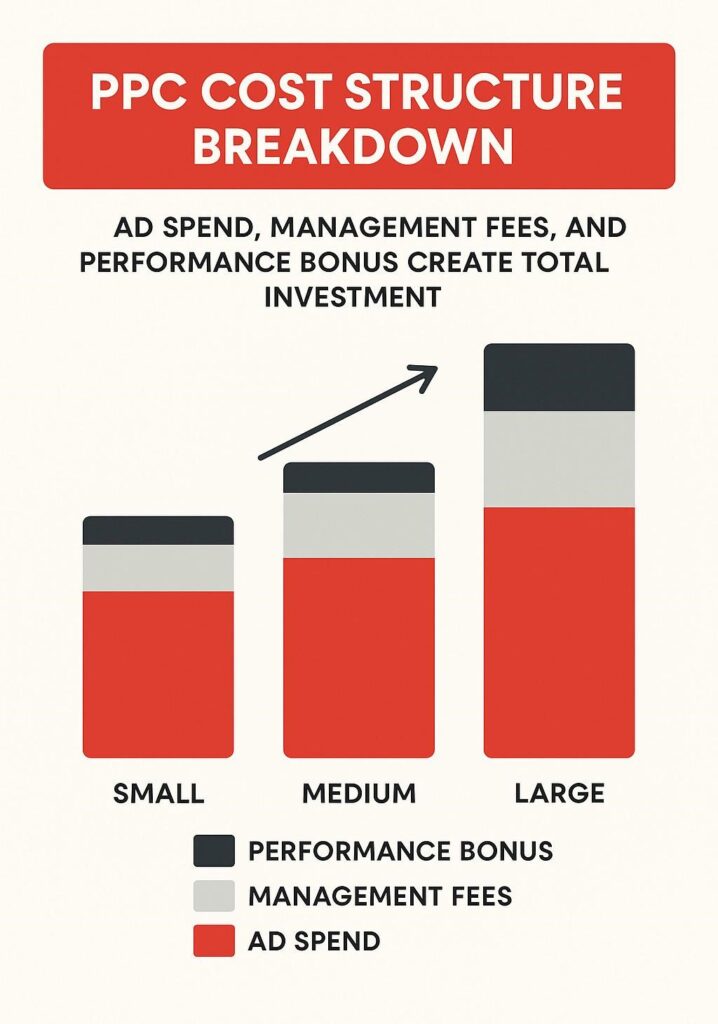
To pick your own level, work backward. Decide how many new customers you want, estimate what share of leads will buy, then divide by your expected cost per lead. That gives you an ad budget before you add fees. Leads aren’t customers, so the next sections show how to turn these numbers into profit. At the $300 level, build a small content calendar around two or three content pillars (recurring themes such as tips, behind-the-scenes, and customer stories) rather than posting at random.
Hidden Costs to Plan For
The sticker price is never the full social media marketing cost. Plan for these extras:
- Creative. Photos, video editing, and design take either money or your own hours.
- Management and setup fees. Ask about onboarding, minimum contract lengths, and required ad spend. WebFX’s entry plan lists $100 of required boosted-post spend on top of its fees.
- Tools. Meta Business Suite is free to use for scheduling and a basic content calendar. WebFX notes that full-featured schedulers like Buffer or Hootsuite start around $100 a month, so check current prices.
- Influencers. Payment may include fees or free products. Under the FTC’s Disclosures 101 guidance, any material connection, including free product, must be clearly disclosed in the post. A platform’s built-in label may not be enough on its own (FTC guide).
- Customer photos (UGC). Ask for written permission, even by direct message, before reposting, and tag the customer. Don’t pay for fake followers or likes, since an FTC rule effective October 21, 2024 bars buying fake indicators of social media influence.
How to Lower Your Cost per Result
- Start with one platform where your customers already spend time. Add a second only when the first is working.
- Plan content ahead. A content calendar built on your pillars saves hours each week.
- Reuse video. A Reel can become a YouTube Short with little extra work.
- Use social proof. Reviews and customer photos, with permission, cost nothing to collect and give ads credibility.
- Test creative, not just audiences. Experts quoted in WordStream’s 2026 report say creative increasingly acts as your targeting.
- Fix tracking. The same report advises setting up Meta’s Conversions API so the platform learns from real sign-ups.
- Review weekly. Pause weak ads and move budget to the ones that produce leads.
Cost vs Profit With Simple Math
Spending is only worth it if each new customer brings in more gross profit than it costs to win them. Use three formulas: cost per lead, cost per customer, and return on ad spend (ROAS). Run them monthly with your own numbers.
- Cost per lead (CPL) = ad spend ÷ leads.
- Cost per customer = total spend (ads plus fees) ÷ new customers.
- ROAS = revenue from those customers ÷ ad spend.
Worked example. These are made-up assumptions to show the math, not benchmarks. You spend $1,000: $600 on ads and $400 on help. At the $27.39 cost per lead, you get about 22 leads. Suppose 20% become customers, which is 4.4 customers.
- Cost per customer: $1,000 ÷ 4.4 ≈ $227.
- If each customer spends $150 once, revenue is $660, so ROAS is $660 ÷ $600 = 1.1. That doesn’t cover your $1,000 total.
- If each customer spends $450 over time, revenue is $1,980, so ROAS is $1,980 ÷ $600 = 3.3, and you’d clear your total spend.
The lesson: know your average customer value before you set a budget. Compare it to gross profit, not revenue, for a true read.
DIY or Agency
DIY keeps social media marketing cost low in cash but high in time, plus tools and creative. It suits a simple offer, one platform, and an owner who can post consistently and check results weekly. An agency or freelancer suits you if you run several locations, spend meaningful money on ads, or can’t protect the hours.
Before you sign, ask:
- What exactly do the posts, platforms, and creative include?
- Do reports show leads and customers, or only likes?
- Who owns the accounts and ad account, and is ad spend billed to my card?
- Are there setup fees or long contracts?
Our guide to social media management explains what a good monthly routine looks like. We sell this service ourselves, so weigh our view accordingly. If you want a second opinion on your budget, see our social media marketing services.
Frequently Asked Questions
How much should a small business spend on social media advertising?
In WebFX’s survey, the most common answer was $1,000 to $25,000 a year. Start with an amount you can afford to run long enough to gather real data, then scale what works.
Can I do social media marketing without paying for ads?
Yes. Organic posting costs time instead of ad spend, but reach is limited and growth is slower. Many businesses post organically and add a small ad budget to promote the best content.
How long before I see results?
Ads can produce leads within days, while organic audiences build over months. Judge a campaign on a few weeks of data, not a few posts.
Do I have to disclose influencer partnerships?
Yes, if the influencer has a material connection to you, such as payment or free product. The disclosure must be clear in the post itself, and you share responsibility for it.
Can I repost customer photos on my business page?
Only with the customer’s permission. Ask in writing, credit them, and don’t edit their words to imply more than they said.
Social media marketing cost isn’t one number. It’s a mix of fees, ad spend, creative, and your own time, so budget for all four and track what each produces. Start small, measure leads and customers, and raise spending only when the math works.
Note: Prices and platform screens change often. We checked the sources below on November 13, 2026, and the cost figures reflect each source’s own date.
Sources: WebFX social media marketing cost survey (updated Aug. 14, 2025) · WordStream by LocaliQ, Facebook Ads Benchmarks 2026 · The Search Sherpa, social media management pricing (Aug. 7, 2026) · FTC, Disclosures 101 for Social Media Influencers · FTC rule on consumer reviews and testimonials (Federal Register, Aug. 22, 2024)