



Running high-end Google Ads for spas is the fastest, most effective way to flood your booking calendar with luxury clients looking for premium treatments in 2026. In this comprehensive industry guide, Good Review Service will walk you through setting up hyper-targeted local campaigns that bypass low-value window shoppers and directly capture high-intent guests. You will learn the exact bidding strategies, high-ROI search terms, and landing page frameworks needed to scale your spa’s monthly revenue, maximize your booking conversions, and dominate your local wellness market this year.
What is Google Ads for Spas?
Google Ads for spas is a targeted online advertising strategy that allows wellness centers, day spas, and medical spas to display paid advertisements to local clients at the exact moment they search for treatments on Google. Operating primarily on a Pay-Per-Click (PPC) model, this digital marketing channel ensures that your business appears at the very top of Google Search results, Google Maps, and partner websites, meaning you only pay when a high-intent prospect clicks on your ad to visit your booking page or call your reception desk.
Why Google Ads Work for Spas
Google Ads is highly effective for spas because it captures potential clients at the exact moment of peak purchasing intent. Unlike social media marketing where users passively browse, Google positions your business in front of people who are already actively looking to book a treatment.
This platform works exceptionally well for the wellness industry due to three primary reasons:
- Captures High-Intent Local Searchers: By bidding on specific keywords like “best medical spa near me“ or “hydrafacial booking,” your spa appears at the absolute top of search results. You bypass cold audiences and connect directly with local clients ready to make an immediate appointment.
- Targets High-Value Treatments: Google Ads allows you to target affluent zip codes and specific household income brackets. This ensures your ad spend is focused strictly on luxury consumers who can afford premium, high-ticket packages like laser resurfacing, microneedling, or full-day retreats.
- Controls Booking Seasonality: The platform gives you total control over your booking calendar. You can aggressively scale up your ads during high-demand gift card seasons like Mother’s Day, or trigger targeted campaigns to fill empty weekday time slots and maximize your room capacity.
Before You Launch a Spa Google Ads Campaign
Set Up Google Ads and Google Tag Manager
Before launching your campaign, linking your Google Ads account with Google Tag Manager (GTM) is essential. GTM acts as a centralized tracking hub, allowing you to automatically capture and sync user behaviors from your website to Google Ads without hardcoding tracking scripts manually.
Configure Essential Conversion Tracking
To optimize your ad spend and attract qualified leads, your spa campaign must track these four core primary conversion actions:
-
Desktop phone calls: Tracks when a user views your website on a computer and manually dials the displayed hotline. Google uses dynamic call-forwarding numbers to accurately attribute these offline calls.
-
Mobile phone calls: Tracks when a user lands on your mobile site via an ad and taps the clickable phone number link to call your front desk instantly.
-
Contact form submissions: Tracks when a visitor fills out and submits an appointment request, consultation form, or intake questionnaire on your landing page.
-
Live chat inquiries: Tracks real-time engagement when a prospective client submits their contact info (name, phone, or email) through an integrated website chat widget.
Why Conversion Tracking Matters for Spa Advertising
Running ads without conversion tracking wastes your budget. Initially, Google Ads enters a data-gathering phase, optimizing primarily for clicks. Once your account accumulates enough actual call and booking data, you can confidently switch to smart bidding strategies like Maximize Conversions or Target CPA. Google’s algorithm will then automatically increase bids for high-intent users to consistently fill your spa’s open time slots.
Create Landing Pages That Convert Spa Visitors Into Clients
Avoid Sending Traffic to the Homepage
Sending paid traffic directly to your website’s homepage is a common marketing mistake that dilutes your ad spend. A homepage is typically broad and offers too many competing navigation paths. When users are looking for a quick solution to a specific problem, a generic homepage forces them to hunt for information, causing them to leave your site and driving up your bounce rates.
Build Dedicated Pages for Individual Services
To achieve strong conversion rates, you must route your traffic to highly targeted service or landing pages that perfectly mirror the specific search intent of your keywords.
- Hydrafacial: Direct prospects searching for specialized skin rejuvenation to a dedicated Hydrafacial page highlighting the immediate glowing results, steps of the treatment, and exclusive first-time client packages.
- Chemical Peels: Build a page that explicitly targets varying skin concerns—such as hyperpigmentation or acne scarring—explaining the specific peel depths and minimal recovery time involved.
- Dermal Fillers: Route search terms for volume restoration here. Highlight localized solution areas like cheek or lip fillers, backed by clear, authoritative copy that focuses on volume and contours.
- Botox: Create a highly optimized page addressing wrinkle reduction and fine lines. Keep the focus squarely on anti-aging treatments to match high-intent transactional search queries.
- Laser Treatments: Dedicate a specific page to advanced laser therapy, clearly addressing skin conditions like sun damage repair, hair removal, or tattoo clearance.
Essential Elements of a High-Converting Spa Landing Page
A high-converting spa landing page eliminates friction and gently guides the visitor toward taking immediate action. Every dedicated service page should integrate these fundamental components:
- Prominent Dual Calls-to-Action (CTAs): Feature an unmissable click-to-call phone button alongside a direct appointment booking button that instantly anchors to a scheduling form.
- Single-Page Booking Forms: Avoid routing users through multiple open tabs. Keep the consultation or intake form directly on the page to maximize scheduling efficiency.
- Aesthetic Trust Factors: Integrate highly authentic, real-world visual assets showcasing your staff, clean clinical environment, and verified 5-star customer testimonials.
- Consistent Copy Matching: Ensure your page headlines and introductory text exactly echo the marketing hooks used in your Google Ads copy to provide a seamless user experience.
Keyword Research for Spa Google Ads
Focus on High-Intent Local Search Keywords
To maximize your advertising efficiency, your keyword strategy must focus heavily on high-intent search terms. Instead of targeting broad informational queries that waste budget on users who are just browsing, select transaction-oriented terms that signal a clear readiness to book an appointment.
Use Service + Location Keywords
Combining your specific spa treatment with your target geographic area is one of the most reliable ways to capture qualified local leads.
Hydrafacial Murrells Inlet: Pinpoints users actively looking for advanced skincare treatments in that exact vicinity.
Botox Murrells Inlet: Captures immediate demand for anti-aging cosmetic injectables locally.
Med Spa Murrells Inlet: Targets high-intent consumers looking to locate and visit a full-service aesthetic clinic near them.
Target “Near Me” Searches
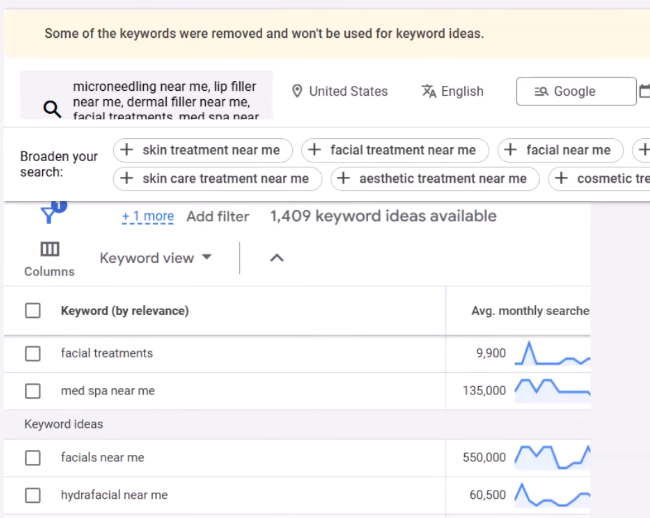
Mobile users frequently search for immediate wellness and beauty solutions using location-based phrases. Incorporating terms like “massage therapist near me,” “dermal filler treatment near me,” or “facial spa near me” allows you to intercept local clients at the precise moment they are ready to schedule a session.
Prioritize Exact Match and Phrase Match Keywords
When launching a new spa campaign, strictly avoid broad match keywords to prevent Google from serving your ads on irrelevant, costly variations.
Exact Match (using brackets [ ]): Gives you maximum control by ensuring your ad only triggers when a user types the exact phrase or search intent you specified.
-
Keyword:
[botox injections] -
Triggers: “botox injections” or “injections botox” (will not trigger for “botox side effects” or “how long does botox last”)
Phrase Match (using quotes " "): Provides a balance of flexibility and control, allowing your ad to show for searches that include the core meaning of your keyword, which helps gather baseline conversion data.
-
Keyword:
"facial spa" -
Triggers: “best facial spa near me” or “facial spa packages in Murrells Inlet”
Negative Keywords to Reduce Wasted Ad Spend
Protect your ad budget by actively building a negative keyword list to exclude searches that will never generate revenue. For a premium spa or med spa, you should immediately exclude terms related to DIY solutions, employment, or ultra-low-cost alternatives. Ensure you filter out phrases such as “free massage,” “massage school,” “massage therapist jobs,” or “cheap coupons” so you only pay for highly qualified traffic.
How to Structure Google Ads Campaigns for a Spa
Organize Campaigns by Service Category
When launching your marketing strategy, a highly effective approach is to group your targeted keywords within a single initial campaign to control costs using a maximum cost-per-click (CPC) bid limit. As your account accumulates more conversion data over time, you can scale the account structure by separating different services into their own standalone, dedicated campaigns . This sequential organization allows you to steadily expand your budget toward more expensive or highly competitive services once your core baseline tracking is established.
Create Separate Ad Groups for Each Service
To maintain high keyword relevance, you must separate individual spa treatments into tightly focused, independent ad groups rather than mixing unrelated services together. Each distinct treatment type requires its own distinct ad group setup:
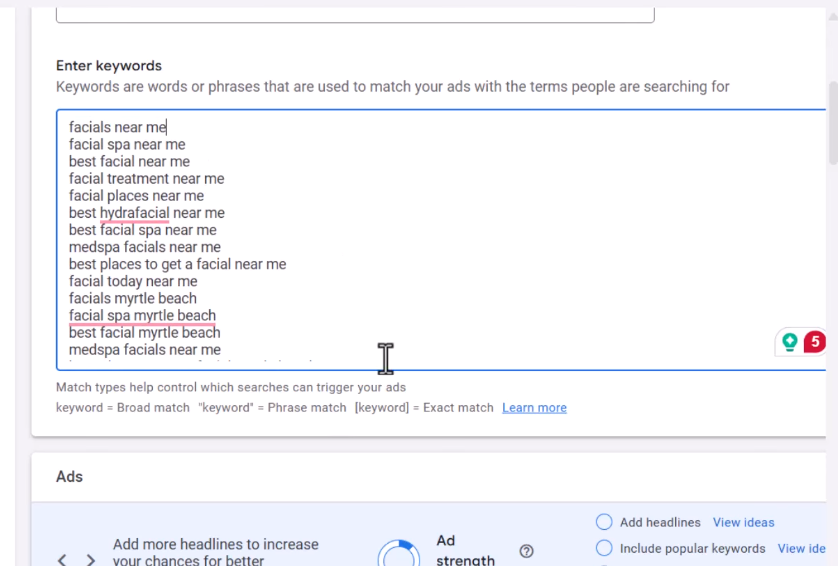
- Facials & Skin Treatments: Creating a dedicated group for keywords like “facials near me” or “facial spa” ensures you avoid overly broad targeting and can serve ad text specifically written about skincare treatments .
- Dermal Fillers: This group focuses precisely on volume-restoration search terms such as lip fillers or dermal fillers near me, matching them directly with corresponding treatment pages.
- Laser Services: This category enables you to target highly specialized requests, such as laser skin tag removal, to capture clients seeking advanced medical spa technology.
Why Granular Campaign Structure Improves Performance
A tightly clustered, granular structure prevents your ad groups from becoming too broad, which directly improves targeting precision. By breaking services down into specific ad groups, you can ensure that the headlines and descriptions in your ad copy perfectly match the specific search intent of the keywords being targeted. Furthermore, a granular configuration allows you to route traffic to the most relevant possible landing page or website service page for that exact treatment . This seamless alignment across your entire funnel significantly enhances your campaign’s conversion rates, optimizes your budget efficiency, and maximizes the overall financial return on your advertising spend.
Setting Location Targeting for Spa Advertising
Choose a Realistic Service Radius
When establishing location targeting for your campaign, focus strictly on areas where your target audience lives or works . Instead of broadly targeting an entire state or country, set a precise radius around your actual physical office address. This prevents your budget from being spent on distant users who are highly unlikely to travel for a treatment.
Step-by-step setup guide:
-
In your Google Ads campaign settings, navigate to the Locations section .
-
Select Enter another location and click on Advanced search.
-
Choose the Radius option.
-
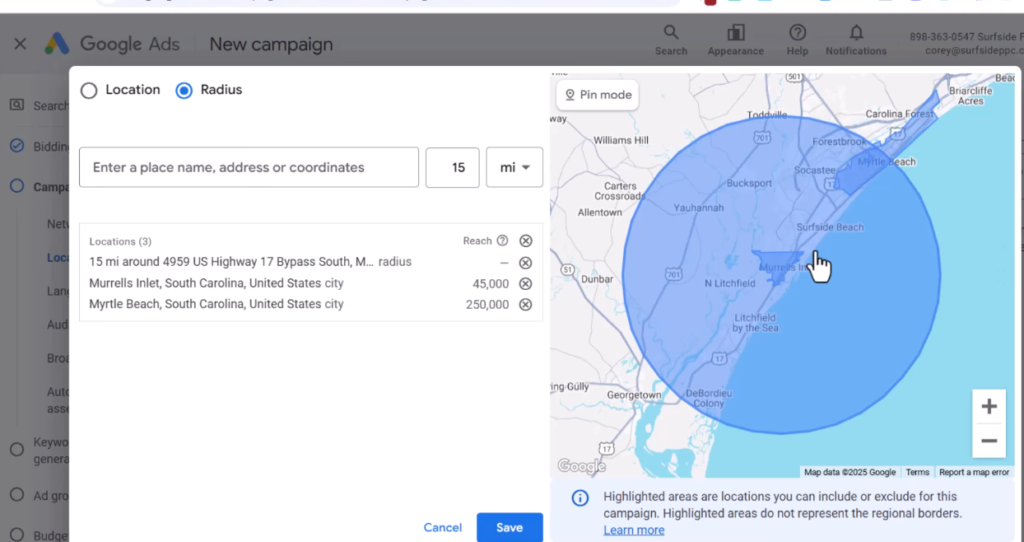
Enter your spa’s exact physical address, set your preferred distance unit, and hit Target .
Why a 15-Mile Radius Often Works Best for Local Spas
A 15-mile radius around your facility is generally the sweet spot for a local spa or med spa campaign. Most prospective clients are unwilling to drive long distances or travel from far-away neighborhoods for standard aesthetic appointments or wellness services. Restricting your campaign to a 15-mile boundary concentrates your ad impressions within a realistic driving distance, maximizing local visibility among high-intent customers .
Exclude Locations Outside Your Service Area
To protect your budget from being wasted on accidental clicks, explicitly add surrounding regions and distant cities that fall outside your 15-mile radius to your campaign’s exclusion list. Additionally, adjust your advanced location settings to target based on physical presence.
Step-by-step setup guide:
-
Under the Locations section, expand the Location options dropdown menu .
-
Under Target, switch the default setting from Presence or interest to Presence: People in or regularly in your targeted locations . This simple setting ensures your ads only trigger for people physically within your reachable market, rather than out-of-town tourists who are merely researching your area .
-
To exclude a location, open Advanced search, type the names of nearby large cities or counties outside your driving radius, and click Exclude.
Writing High-Converting Google Ads for Spa Services
Create Attention-Grabbing Headlines
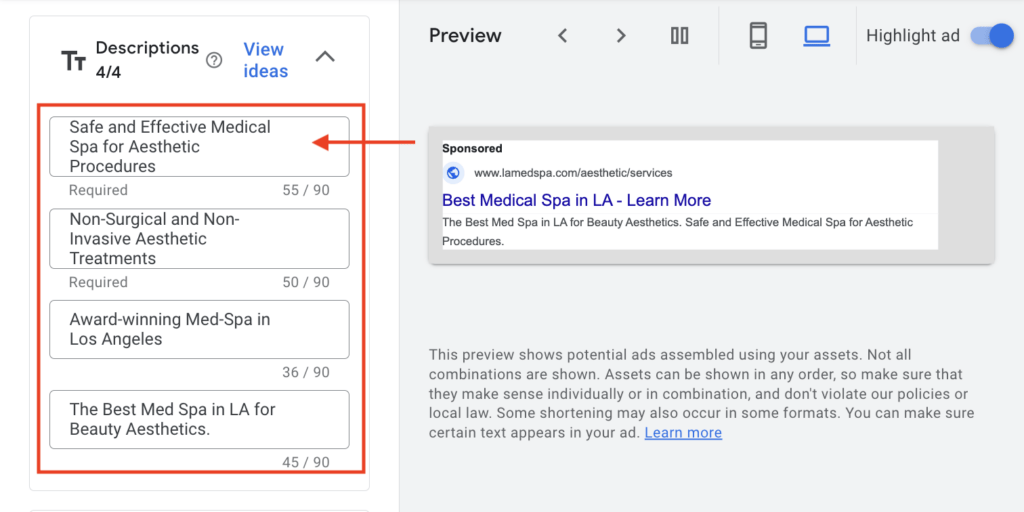
Your headlines are the first elements a prospective client notices on the search results page. To maximize impact, utilize Title Case formatting and keep your text tightly aligned with the user’s exact search query . For example, incorporating Dynamic Keyword Insertion (DKI) automatically updates your headline to match the user’s specific query (e.g., “Remove Skin Tags Today”) to instantly grab their attention . Additionally, weave your local geographic market directly into your titles-such as “Expert Mole Removal in Murrells Inlet”-to signal immediate regional relevance.
Highlight Benefits and Unique Selling Points
Do not just list the generic names of your treatments; instead, clarify exactly what makes your spa the superior local choice. Use your limited character space to highlight the immediate results, advanced clinical technology, or premium status of your practice.
- Focus on authoritative credibility: “5-Star Rated Clinic” or “Certified Aesthetics Experts”.
- Highlight physical outcomes and comfort: “Flawless Skin Awaits,” “Pain-Free Lesion Removal,” or “Advanced Skin Solutions”.
Add Strong Calls-to-Action
Prospective clients browsing for a spa need an explicit, friction-free directive on what action to take next. Ensure every single ad variation contains an explicit, high-intent call-to-action (CTA) embedded directly in both the headlines and description lines. Incorporating phrases like “Call Now to Book,” “Schedule a Consultation,” or “Claim Your First-Time Discount Today” effectively nudges the user off the search page and straight onto your online booking form.
Use Ad Extensions to Improve CTR
Ad extensions (now referred to as assets) expand the physical footprint of your ad on Google, providing extra context that significantly boosts your Click-Through Rate (CTR).
- Sitelinks: Direct users straight to secondary high-value website pages-such as your pricing menu, client photo gallery, or booking page-allowing them to bypass the main landing page if they choose.
- Call Extensions: Display a prominent, clickable phone number asset alongside your ad copy. This allows high-intent mobile searchers to tap a single button and call your front desk directly without ever needing to click through to your website.
- Location Extensions: Sync your Google Ads with your Google Business Profile to dynamically display your physical street address, operational hours, and proximity right below your text ad, helping nearby searchers find your facility instantly.
- Callouts: Include short, punchy 25-character bulleted phrases that highlight ongoing perks throughout your facility. Use callouts to continuously promote structural selling points like “Ample Free Parking,” “Open Weekends,” “Licensed Therapists,” or “Flexible Scheduling.”
Choosing the Right Bidding Strategy
Start With Manual CPC for Better Control
-
Maximum Cost Control: Allows you to manually cap the maximum price you pay for every single click on a keyword-by-keyword basis.
-
Budget Protection: Prevents Google from overspending on highly inflated, competitive local search terms during your launch.
-
Control Over Delivery: Ensures your daily budget is distributed exactly where you intend, rather than letting an automation tool overspend early on.
Why New Spa Campaigns Should Avoid Immediate Smart Bidding
-
Zero Historical Data: A brand-new Google Ads account has no past data on which keywords or demographics actually result in phone calls or bookings.
-
Blind Optimization: Forcing automated bidding on day one makes Google’s machine learning optimize blindly, often wasting budget on low-intent clicks.
-
Premature Budget Exhaustion: Automated systems need data to perform; without it, they can quickly drain your funds without generating actual spa clients.
When to Switch to Maximize Conversions
-
Data-Gathering Milestone: Transition your campaign only after gathering a steady, predictable volume of monthly conversions.
-
Recommended Volume: Wait until your account records at least 15 to 30 conversions over a consistent 30-day period.
-
Algorithm Efficiency: With sufficient data, Google can accurately identify high-intent users and automatically adjust bids in real time to maximize your bookings.
Using Target CPA After Gathering Enough Data
-
Cost Predictability: Once conversion volume is stable under Maximize Conversions, layer on a Target CPA (Cost Per Acquisition) cap.
-
Define Your Lead Value: Tell Google exactly how much your spa is willing to spend to acquire a single customer booking.
-
Protect Profit Margins: Google uses your historical tracking data to dynamically adjust individual bids, keeping your average acquisition cost in line while scaling your business.
Final Thoughts
Mastering google ads for spa campaigns is the single most effective strategic move a wellness business owner can make to secure predictable, long-term local client growth. By aligning your digital campaigns with explicit local keywords, high-converting landing pages, and strict geographic radius targeting, you build a high-performance customer acquisition engine that keeps your treatment rooms full.
Don’t let an unverified online presence limit your business growth potential. Contact Good Review Service Today to discover how our specialized reputation engineering can complement your paid search campaigns. Let us help you turn everyday local internet searches into a steady stream of loyal, high-value clients!